Back to All Solutions

Solution Detail

SD-WAN Selection and Deployment Acceptance

Multiple Underlays, Application Recognition, Dynamic Routing, QoS and Failover

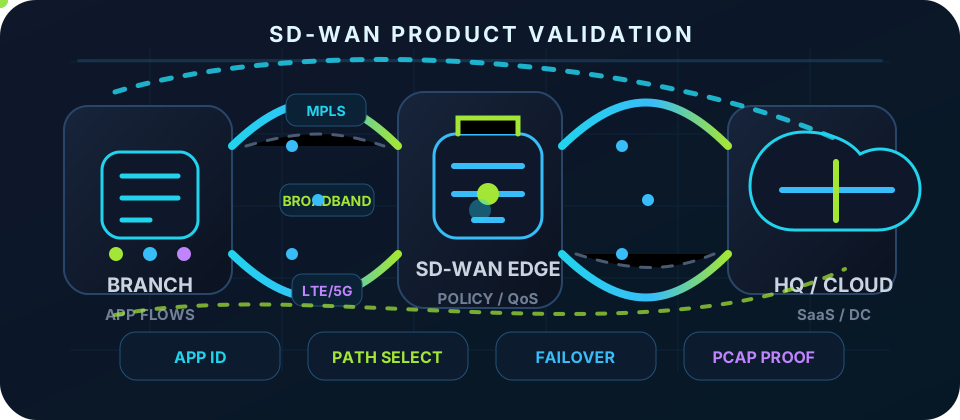
Reproduce realistic MPLS, broadband, LTE/5G, satellite and cloud impairments for SD-WAN development, selection and pre-deployment testing. Validate application recognition, routing, QoS, failover, tunnels and SLA performance.

SD-WAN product and multi-underlay deployment validation diagram

Products

4

Scenarios

10

Evidence

PCAP

Why

Requirements

SD-WAN places applications on appropriate underlays according to policy, quality and security—not merely aggregated links. MPLS often carries critical traffic; broadband and LTE/5G add capacity, internet access or backup; satellite and cloud paths introduce delay and variability. Tunnel establishment alone cannot establish reliable routing, QoS, failover or experience.

MEF 70.2 defines externally visible SD-WAN service behavior through attributes and a framework. Test SD-WAN edges, controllers, CPE, Underlay Connectivity Services, Tunnel Virtual Connections, applications, policies and quality goals together, rather than single-link throughput alone.

Use for vendor R&D, enterprise bakeoffs, managed SD-WAN delivery, branch rollout, SASE/security integration and cloud-edge optimization. Turn claims about intelligent routing, application assurance, failover, economical links and secure access into repeatable, measurable evidence.
Topology

Test and Deployment Topology

STEP 1Headquarters / Branch / Cloud Application Models
STEP 2SD-WAN Gateway or CPE
STEP 3ChaosBridge Multi-Underlay Emulation
STEP 4NetAccura Traffic Generation Packet Loads
STEP 5BestPerf SLA and User-Perceived Quality
STEP 6Flow Hunter Tunnel Sessions and QoS Evidence
STEP 7NetAccura Traffic Generation PCAP Replay and Bakeoff Report

How

Implementation

1

Build a Multi-Underlay Topology

Model headquarters, branches, data centers, cloud entries and internet exits. Place SD-WAN gateways/CPE at the user side and ChaosBridge in each MPLS, broadband, LTE/5G, satellite or cloud path. Configure bandwidth, RTT, jitter, loss, reordering, bursts and outages independently as repeatable WAN profiles.

2

Generate Loads and Connect Real Applications

Configure background packets with different rates, sizes, addresses, ports and DSCP markings to inspect multi-stream forwarding and QoS. Real clients/servers run conferencing, VoIP, web and transfers; existing PCAP samples can assist recognition validation.

Product Stack

Core Emulator and Supporting Tools

Result

Expected Outcomes

Replace Subjective Demos with Same-Scenario Comparisons

Compare vendors, models and policies under identical MPLS/broadband/LTE/5G profiles and application mixes, reducing reliance on demonstrations and datasheets.

Find Routing and QoS Limits before Deployment

Expose recognition errors, policy conflicts, ineffective QoS, slow switching, inadequate backup SLA and congestion affecting critical services before users encounter them.

Quantify Failover and Recovery

Report failover and interruption times, loss, recovery paths, session state and PCAP evidence for acceptance, remediation and vendor collaboration.

Produce Reviewable Reports and Evidence

Deliver more than throughput or delay figures: include topology, parameters, timelines, quality curves, key sessions, anomalies, PCAP extracts and retest results. Development, testing, operations, vendors and customers can discuss the same evidence rather than relying on screenshots, verbal descriptions and repeated debate.

References

Related Standards and Methods

Next Step

Need to Apply This Solution to Your Network?

NetAccura can create a test topology, parameter table and POC plan based on your links, models, application protocols, available PCAPs and SLA goals.