1
Map the 5G Topology and Key Interfaces
Identify gNB, 5GC, UPF, IMS/SBC, CPE/UE or private-network gateways and N1/N2/N3/N6, IMS and user-plane paths. Record protocols, five-tuples, TEIDs, roles and observation points.
Solution Detail
Selective NAS/SIP/GTP Drops, Abnormal Procedures and Recovery
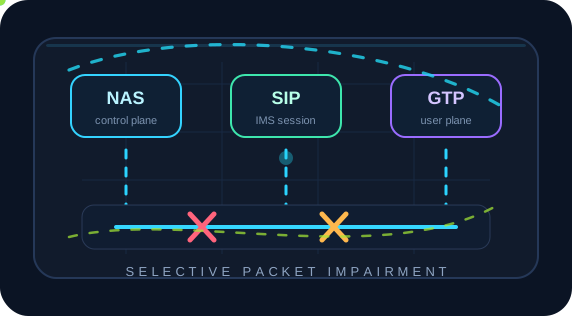
Move 5G device robustness testing beyond generic link loss to selective impairments by protocol, procedure, message type and time window, checking state stability, continuity and recovery.
Core Emulation Equipment
Products
4
Scenarios
6
Evidence
PCAP
Why
Public IMT-2020(5G) specifications address availability, integrity, authentication/authorization, data protection, vulnerabilities and robustness. Robustness means checking registration failures, hung sessions, bearer leaks, dropped calls, user-plane black holes and slow recovery when control, IMS and tunnel traffic are impaired.
3GPP TS 24.501 defines 5GS NAS registration, authentication, mobility and session procedures; RFC 3261 defines SIP multimedia control; 3GPP TS 29.281 defines GTPv1-U tunnels. Selective loss, delay, reordering and bursts test access control, IMS/voice sessions and user-plane bearers separately.
Apply targeted rules by interface, five-tuple, protocol, message, procedure stage and time window instead of indiscriminate loss. Drop selected NAS responses, SIP 183/200/ACK/REGISTER or GTP-U packets by TEID/direction to inspect gNB, 5GC, IMS, CPE/UE and private-network gateway behavior.
Topology
How
Identify gNB, 5GC, UPF, IMS/SBC, CPE/UE or private-network gateways and N1/N2/N3/N6, IMS and user-plane paths. Record protocols, five-tuples, TEIDs, roles and observation points.
Apply conditional impairments with ChaosBridge: NAS registration, authentication, PDU session and mobility; SIP registration, setup, early media, ACK/BYE; GTP loss/reordering by TEID, direction or slice.
Replay known NAS/SIP/GTP PCAPs or production issue samples. Use another device for simultaneous generated user-plane load. Full registration and calling still run through the relevant network elements or protocol test tools.
Flow Hunter inspects signaling, GTP tunnels, session durations, retries, timeouts, recovery paths and captures around the impairment point. BestPerf measures end-to-end RTT, loss, jitter and throughput to check service recovery.
Record protocol, message type, drop ratio, consecutive-loss length, impairment window and outcome: pass, recoverable degradation, interruption with automatic recovery, manual intervention, invalid state or crash. Use the matrix for qualification, regression and vendor diagnosis.
Product Stack
Core Emulation Equipment
Optional Supporting Tools
Flow Hunter
Capture passively through mirrored ports or TAPs for L2-L7 analysis, session investigation, protocol-stage diagnosis and PCAP export.
NetAccura Traffic Generation
Generate L2-L3 test streams. Software models also replay Ethernet PCAPs, rewrite IPv4 addresses and TCP/UDP ports, and multiply traffic for performance, security detection and issue reproduction. Stop all transmit tasks before switching modes. Simultaneous generation and replay require separate devices.
BestPerf
Actively measure RTT, directional loss, jitter, micro-outages, TCP goodput and quality under load to establish link baselines.
Result
Define input conditions, expected behavior, results and evidence for every protocol, procedure and impairment instead of vague loss-tolerance claims.
NAS faults reveal registration, authentication and session limits; SIP faults expose IMS/voice recovery; GTP faults reveal bearer, TEID, QoS and recovery issues.
Standardize cases and rerun the same impairment matrix after upgrades to detect robustness regressions.
Deliver more than throughput or delay figures: include topology, parameters, timelines, quality curves, key sessions, anomalies, PCAP extracts and retest results. Development, testing, operations, vendors and customers can discuss the same evidence rather than relying on screenshots, verbal descriptions and repeated debate.
References
CAICT's public project describes vulnerability scanning, fuzzing, attack simulation and signaling emulation for 5G base stations and core equipment, covering data protection, availability, integrity, vulnerability and robustness.
3GPP TS 24.501 defines the 5G System Non-Access-Stratum (NAS) protocol, a control-plane foundation for registration, authentication, mobility and session management.
SIP is an application-layer control protocol for creating, modifying and terminating multimedia sessions, commonly used in IMS/VoLTE/VoNR signaling.
3GPP TS 29.281 defines GTPv1-U user-plane tunneling for mobile networks including LTE and 5G.
Next Step
NetAccura can create a test topology, parameter table and POC plan based on your links, models, application protocols, available PCAPs and SLA goals.