1
Map RDMA Traffic Domains
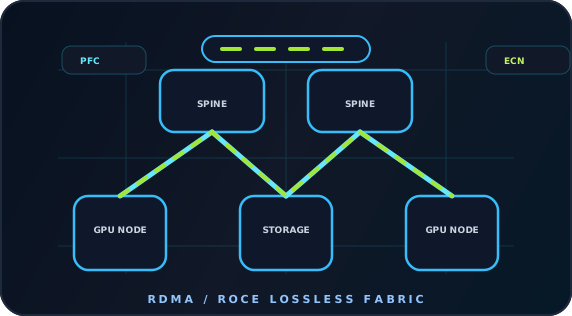
Identify GPU/storage nodes, switches, VLAN/DSCP/PCP, PFC priorities, ECN thresholds and RoCEv1/v2 settings. Verify path, MTU and QoS consistency.
Solution Detail
ChaosBridge WAN Emulator + RoCEv2/PFC/ECN Lab Validation
Lab validation for product R&D and research into low latency, low loss, congestion control and failure limits of AI, HPC and storage RDMA/RoCE networks. Work at deployment/delivery stages is acceptance testing.
Core Emulation Equipment
Products
4
Scenarios
8
Evidence
PCAP
Why
RoCE brings RDMA to Ethernet for hardware-assisted direct memory access, reducing CPU use and latency. RoCE v2 runs over UDP/IPv4/IPv6, commonly destination port 4791. Microbursts, loss, PFC storms, ECN thresholds and QoS affect GPU training, storage and HPC efficiency and tail latency.
R&D validation deliberately creates failure and boundary conditions for NICs, switches, AI fabrics and storage networks. Deployment, delivery and change acceptance instead confirm that an existing network meets agreed requirements.
Ping and iperf alone miss RoCE issues. Use ChaosBridge for loss, jitter, bandwidth reduction, micro-outages and link failures, alongside east-west load, bursts, queue congestion, PFC/ECN and low-delay path changes. Correlate active tests and passive evidence to isolate limits.
Topology
How
Identify GPU/storage nodes, switches, VLAN/DSCP/PCP, PFC priorities, ECN thresholds and RoCEv1/v2 settings. Verify path, MTU and QoS consistency.
Apply loss, jitter, bandwidth reductions, reordering and outages by port, VLAN, priority, five-tuple or time window. Observe whether PFC/ECN, queues, RDMA jobs and storage I/O recover reliably.
Use multi-port east-west packets, varied stream durations and bursts to inspect forwarding and congestion. Actual compute/storage nodes run training synchronization, parameter exchange and I/O.
Measure key links with BestPerf, apply controlled delay/jitter with ChaosBridge, and observe RDMA jobs, storage I/O and throughput.
Flow Hunter observes UDP 4791, queue congestion, retransmissions, sessions and background effects, correlating network events with slow training, storage or failed jobs.
Product Stack
Core Emulation Equipment
Optional Supporting Tools
NetAccura Traffic Generation
Generate L2-L3 test streams. Software models also replay Ethernet PCAPs, rewrite IPv4 addresses and TCP/UDP ports, and multiply traffic for performance, security detection and issue reproduction. Stop all transmit tasks before switching modes. Simultaneous generation and replay require separate devices.
BestPerf
Actively measure RTT, directional loss, jitter, micro-outages, TCP goodput and quality under load to establish link baselines.
Flow Hunter
Capture passively through mirrored ports or TAPs for L2-L7 analysis, session investigation, protocol-stage diagnosis and PCAP export.
Result
Verify PFC, ECN, QoS, MTU and queue stability under load and faults, rather than merely checking configuration presence.
ChaosBridge makes loss, jitter, reduced bandwidth, micro-outages and failures repeatable for product R&D, research and lab comparisons.
Distinguish GPU node, NIC, switch, link, queue and policy causes of performance drops to focus troubleshooting.
Deliver more than throughput or delay figures: include topology, parameters, timelines, quality curves, key sessions, anomalies, PCAP extracts and retest results. Development, testing, operations, vendors and customers can discuss the same evidence rather than relying on screenshots, verbal descriptions and repeated debate.
References
RoCE provides application-level direct memory access over Ethernet using RDMA semantics, reducing CPU involvement and communication latency.
Distinguishes RoCE v1/v2, UDP 4791, hardware requirements and RDMA connection validation scope.
Next Step
NetAccura can create a test topology, parameter table and POC plan based on your links, models, application protocols, available PCAPs and SLA goals.